A strategy workshop is a facilitated working session that brings your decision-makers together—in person or remote—to align on a specific challenge and leave with a documented outcome. Chariot designs and facilitates strategy workshops for organizations that need alignment faster than a months-long process allows, without sacrificing depth. What separates a workshop from a regular meeting is structure and a neutral facilitator: 71% of senior managers say meetings are unproductive and inefficient, according to Harvard Business Review, and a facilitated workshop is built to be the exception.
A strategic workshop runs in three beats, with most of the work happening before anyone enters the room:
Sessions run from a half day to two days, scoped to the decision and the number of voices in the room.

It depends on the decision in front of you. We facilitate three core formats:
Need the full org-wide engagement rather than a single session? That’s strategic plan creation. Not sure which fits? Tell us the decision you’re stuck on, and we’ll point you to the right room.
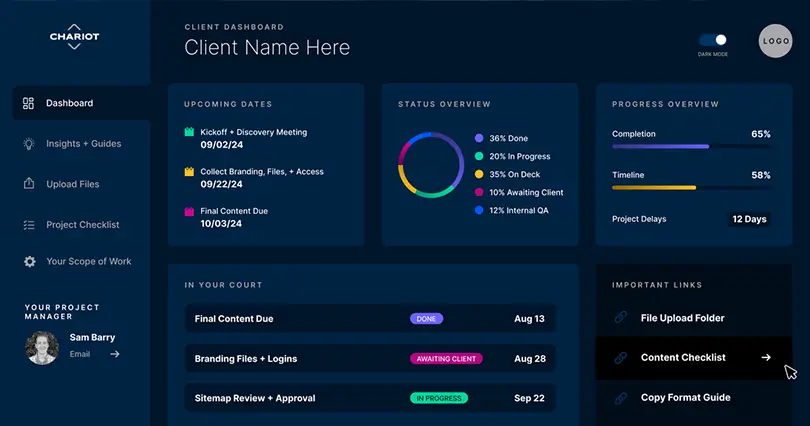
Every workshop we run follows the Throughline Method, our five-stage facilitation framework, adapted to each session’s focus:
Interview stakeholders, survey your audience, review documents and financials, and scan comparable organizations, synthesized into a written Key Findings report.
Facilitate the working sessions where leadership debates trade-offs and commits to priorities.
Turn those decisions into a written plan with goals, owners, and a roadmap.
Build the measurement and follow-through that move the plan off the page and into the work.
Reconvene with leadership and stakeholders each quarter to track progress, fold in organizational changes, and adjust the plan when funding, programs, or leadership shift.
Structure is the whole point. Only half of middle managers can name their company’s top five priorities, according to Harvard Business Review—the method exists to end the session with the room genuinely aligned.



An outside facilitator keeps your leaders in the room as participants, not referees, so honest input surfaces and the group actually decides. When someone with a stake runs the session, people self-edit and the loudest voice tends to win. We stay neutral, hold the agenda, and make sure every voice is heard and every decision gets written down. It matters because alignment that never reaches the room doesn’t hold: 95% of employees don’t understand their organization’s strategy, according to Harvard Business Review.
Both, though we default to remote. We facilitate fully remote workshops with collaborative digital tools, which widens who can attend, trims travel cost, and makes scheduling across busy calendars far easier.
Remote also lets us split a long agenda into shorter, focused blocks over a few weeks, which holds attention better than a single all-day room. We run in person when the moment earns it—brand-new teams, charged decisions, or high-stakes alignment that benefits from being face-to-face.
We facilitate for mission-driven organizations—nonprofits, community groups, and local-government teams—where competing stakeholders and lean budgets make alignment both harder and more valuable. The pattern is consistent: get the right people into one well-run session, and decisions that have stalled for months get made in a day.
Most run from a half day to two full days, depending on the decision and how many people need to weigh in. When we facilitate remotely, we often split that time into shorter sessions across a couple of weeks, which keeps energy and focus higher than one marathon day. We scope the length with you once we know the goal and the group.
Usually five to twelve decision-makers—enough to capture the perspectives that matter, few enough to actually reach decisions. Larger groups work for input-gathering sessions, but tighter groups are better when the goal is to commit. We help you decide who needs a seat before we build the agenda.
A strategy workshop is one focused session aimed at a single decision or alignment goal. Full strategic planning is the org-wide engagement—research, multiple sessions, a written plan, and a roadmap. If your decision is launching a new product or market, a go-to-market strategy engagement may be the better fit.
Every workshop ends with a written summary of the decisions made, who owns each next step, and the timeline. Depending on the session, that may also include a positioning statement, a set of priorities, or a roadmap. The goal is a document your team can act on immediately, not a pile of sticky-note photos.
Mostly, you don’t have to—that’s our job. We handle stakeholder interviews, agenda design, and materials in advance. What we ask of you is to get the right people to commit the time and to come ready to make decisions rather than just discuss. The prep we do beforehand is what makes the session itself efficient.
Yes—that’s our core. We regularly facilitate alignment for nonprofit boards, community organizations, and local-government teams, where competing priorities and limited budgets make a neutral facilitator especially valuable. We bring the structure; you bring the people who need to be aligned.